
Most people only think about their consumer unit when something goes wrong. A circuit keeps tripping, the lights flicker, an electrician carrying out an EICR raises an eyebrow at the old fusebox in the cupboard. By then the board has usually been doing more than it should for years, and the question stops being "should we upgrade" and becomes "how soon can it be done".
How to tell your consumer unit is overdue
There are five clear signals we see again and again on Edinburgh properties. None of them are subtle once you know what to look for.
- Wire fuses or rewireable fuses. If you still pull out a porcelain or plastic carrier with a strand of fuse wire inside, the board predates modern safety thinking by decades.
- A plastic enclosure. Plastic consumer units have been non-compliant on new domestic installations since 2016. They are still legal to leave in, but they will be flagged on any EICR.
- One single RCD covering the whole house. A fault on the kettle takes out the freezer, the boiler control, the upstairs lights and the broadband, all at once. That is the symptom.
- Nuisance tripping you cannot explain. An old RCD ages. The trip threshold drifts. By the time it is dropping the house once a fortnight, it is no longer doing its safety job reliably.
- No SPD (surge protection device). Older boards do not have one. Modern boards do. A nearby lightning strike or a grid spike can write off a TV, a router, a fridge and a hob in one event.
Any one of these on its own is a conversation. Two or more, and you are overdue.
What the 18th Edition changed
The 18th Edition of BS7671 (the UK wiring regulations) brought in several changes that matter for consumer units specifically. Boards in domestic settings now need a non-combustible enclosure, which in practice means a metal-clad unit. Surge protection became the default expectation rather than an optional extra. RCD protection was extended to nearly every circuit rather than just sockets and certain wet rooms.
The regulations were updated again in 2022 (Amendment 2) to tighten arc-fault detection guidance and to clarify the role of AFDDs on high-risk circuits. None of this means an older board is automatically dangerous tomorrow morning. It means that if you are upgrading anyway, the upgrade itself looks quite different to a board that was fitted in 2010.
RCBOs vs the old single-RCD setup
This is the single biggest practical difference between a modern and an older consumer unit.
On the old design, one or two RCDs sat at the front of the board and protected groups of circuits. A fault anywhere in that group dropped the whole group. If you came home to a half-dark house and a fridge that had been off all day, that was usually the culprit.
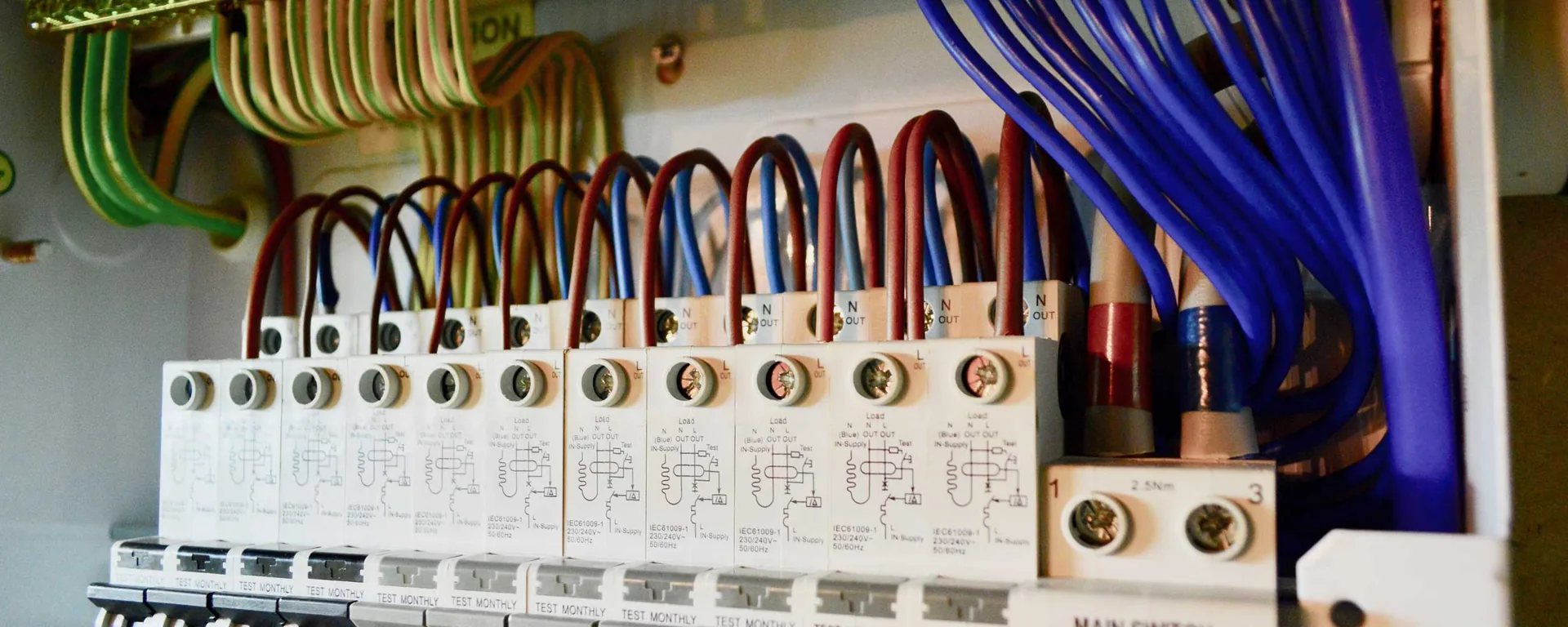
On a modern board, every circuit gets its own RCBO. An RCBO is an RCD and an MCB combined into one device. The fault drops only the circuit that has the problem. The kettle trips its own socket ring, the rest of the kitchen stays on, the freezer keeps running, and you can isolate the fault without standing in the dark.
For a typical three-bed flat that is the difference between losing one socket circuit and losing the whole downstairs. It also makes fault-finding much faster the next time something does go wrong.
Old fusebox in your Edinburgh property?
Chris or Carlos will come out, look at the existing board, and quote in writing. NAPIT registered, free survey, no obligation.
Get a Free QuoteWhat happens on installation day
A standard domestic consumer unit upgrade takes 2 to 4 hours on site. The job runs in the same order on almost every job.
First, we isolate the supply at the meter (the supplier's cut-out fuse comes out, properly logged). The existing board comes off the wall. We label every circuit before disconnecting, so the new board goes back together without guesswork. The new metal-clad unit is fixed in position, usually exactly where the old one was, and the existing circuit cables are transferred across into the new RCBOs.
Then the testing starts. Earth loop impedance on every circuit. Insulation resistance on every circuit. Polarity. RCD operation. SPD function. Earth bonding to gas and water. The full set, on every circuit, before the supply goes back on. Anything that does not pass first time gets investigated and resolved before we close up.
In almost every case the supply is back on the same day. We give you the day before as a heads-up so you can plan around the couple of hours of no power.
What the certificate gives you
On completion you get an Installation Certificate (or a Minor Works Certificate where the scope was smaller), the work is lodged with NAPIT, and the local authority building control is notified where it needs to be. That paperwork is what your landlord agent, your insurer, your solicitor or your mortgage lender will ask for.
For landlords coming up to a five-year EICR, an upgraded consumer unit is one of the most common items that turns a borderline C3 report into a clean satisfactory. For homeowners selling on, it is one of the items prospective buyers' surveyors actually look at. For everyone else, it is a board that does its job quietly for the next 25 to 30 years.
We cover Edinburgh, East Lothian, West Lothian, the Borders, Livingston and Glasgow. If you have an old fusebox, an EICR coming up, or just a board that has been nuisance-tripping more than it should, we are happy to come and take a proper look.
Frequently Asked Questions
A standard domestic upgrade takes 2 to 4 hours on site. That includes isolating the supply, swapping the board, transferring the circuits, testing everything, and bringing the supply back on. The certificate goes out the same day.
No. The supply is only off while the new board is being fitted and the cables are being transferred across, typically a couple of hours. We let you know the day before so you can plan around it. Everything comes back on the same day in almost every case.
If testing turns up anything dangerous or potentially dangerous on an existing circuit, we stop, explain it clearly, and quote you for the remedial before doing it. Nothing gets done you have not signed off on first.
Most domestic consumer unit upgrades land in the £650 to £1,200 range, depending on the number of circuits and any minor remedials uncovered during testing. The price is fixed in writing before we start, after a free site visit.